The era of “post-historical art”, as described in Arthur C. Danto’s book titled After the End of Art, is truly a turning point in the evolution of expression. He marks a period in which “Painting had died through its own historical self-fulfillment” (137), creating a void in a cultural world largely dominated by this treasured medium. What killed the painting? Chances are it was the photograph, which could outcompete any painter in terms of accuracy. The photograph also caused damage to the reputation of the museum, long known as a place where one could view original copies of their favorite pieces of art. The increasingly popular photographic medium, however, called into question the purpose of the museum as a place for seeing original works, as photographic prints are all considered “copies” and there isn’t technically an original (besides film negatives). Overall, the photograph caused an upset in the art world, engendering a variety of responses from both artists and institutions.
There were numerous reactions to the death of painting in the artistic community, the most compelling, in my opinion, being the rise of neo-expressionism. To combat the mechanical accuracy of a photograph, the painter reframed themself as a master of human expression. Danto elaborates further on this when he writes “I suppose neo-expressionist painting was one answer. Since that narrative had ended, why not, forgetting about the economic account, simply use painting as a means for self-expression?” (141). The focus on self-expression put painting back in the running against photography, as it highlighted the human quality of painting, which always led to a unique, expressive outcome. One of my favorite artists, Jean Michel Basquiat, arose during this movement, and was incredibly famous for putting raw, human emotion into his works. Pictured below is Basquait’s piece titled Cabeza, and one can see the impressive amount of feeling he expressed through the medium.

(Cabeza, Jean Michel Basquiat)
The death of painting opened the floodgates for a profusion of new, more experimental mediums. In the process, the definition of art grew out of its classical confines and some began to question the very idea of expression. Danto describes some of these new mediums including “installation, performance, video, computer, and various modalities of mixed media, not to mention earthworks, body art, what I call “object art” and a great deal of art that had earlier been invidiously stigmatized as craft” (136). In our second reading, we begin to explore some of these mediums, focusing on the intersection of performance pieces, language, and photography.
Liz Kotz writes about these new mediums in her piece titled “Language Between Performance and Photography”. In her piece, she describes Joeseph Kosuth’s One and Three Chairs, a piece utilizing three different mediums to represent a chair. I found this piece fascinating both in its deconstructionist style, and in its ability to make the viewer actually question the purpose and definition of art. Kotz writes “As the combination of three equal parts, a photograph, an object, and a text, these works are statements of fact, not simply about external reality, but about the means to represent it” (8). She continues with “[the piece] causes the viewer to reflect on the conditions of representation of this or any object, and on art in general” (9).
Clearly, Kosuth’s work makes the viewer question the various means of representation, as he has expressed the same concept through three very different mediums. Is there a point to this redundancy? Is there an artistic quality to this piece? Burning questions like these are an essential part of the experience, and must be posed. Although the viewer may not think this is beautiful (I don’t necessarily consider this work beautiful), there is no denying the reflection that occurs as a result of experiencing this work.
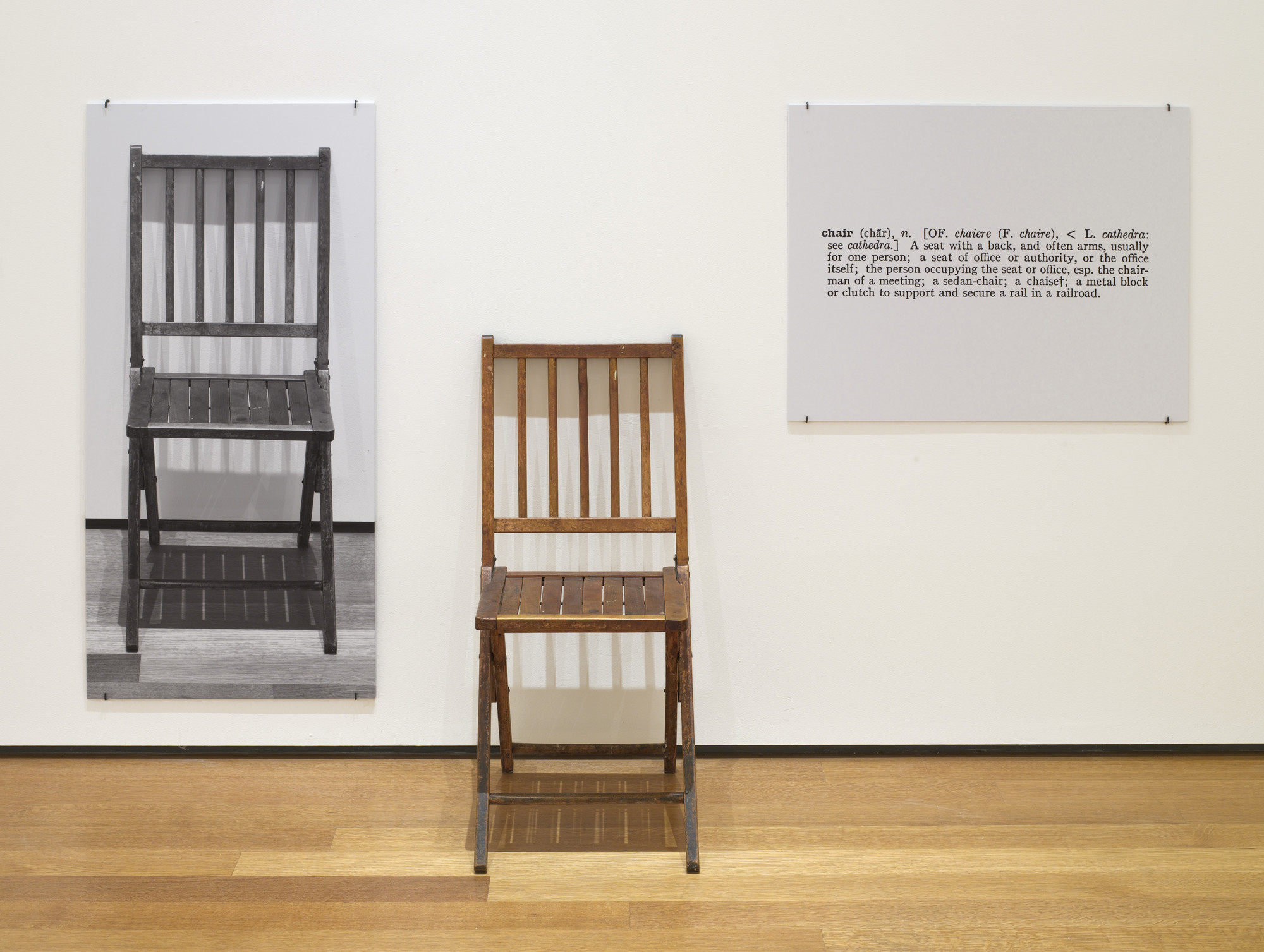
(One and Three Chairs, Joseph Kosuth)
Jenny Holzer’s selection of works titled Truisms are another example of this genre of art. The pieces that encompass this series all contain pithy sayings that Holzer came up with. They are often displayed in busy public settings, and are meant to create dialogue with the viewer. They often express strong opinions, and many of them are personal accounts. In her work pictured below, she writes “Private Property Created Crime” in Time Square. Her commentary on capitalism in an increasingly commercialized, and simultaneously crime ridden, neighborhood of Manhattan would definitely spark conversation amongst pedestrians. Again, the results of viewing this work seem to be reflection and a whole lot of questions.

(Truisms, Jenny Holzer)

 Adam's Contemporary Art Blog